

Risk Management · 2025
In this section2 topics
Risk Management Policy & Plan
Policy & Plan Description
Over the past 20 years, the Company has adopted a risk management framework within the organization, applying international standards such as COSO ERM and ISO 31000 to establish management guidelines aimed at preventing and mitigating various risks that may hinder the achievement of organizational objectives. This aims to build confidence among stakeholders that the Company can continue operating effectively amid today’s fast-changing and dynamic environment.
Executives and employees at all levels across the organization, including joint venture companies, participate in implementing the standardized risk management system alongside the corporate strategic planning process. This is aligned with the Company’s commitment to sustainable business development in conjunction with Environmental, Social, and Governance (ESG) principles. The Company continuously monitors risks on a quarterly basis under the supervision of the Enterprise Risk Management Committee to ensure the collective achievement of business goals, following the organizational risk management structure shown in the diagram.
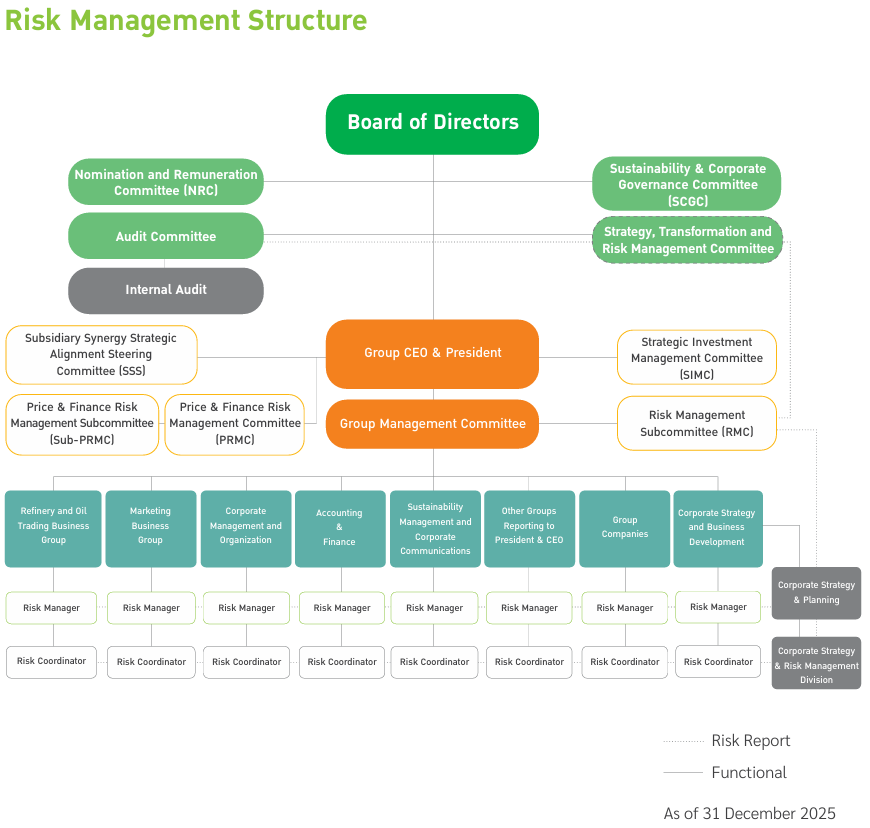
In 2025, the Company’s Board of Directors resolved to rename the Enterprise Risk Management Committee (ERMC) to the Strategy, Transformation and Risk Management Committee (STAR). The committee’s scope of authority was expanded beyond risk management and oversight to include driving strategy and organizational transformation. This covers strategic review, investment screening, proactive portfolio management, transformation initiatives, organizational structure review, and policy formulation—while maintaining strong risk management oversight.
The Bangchak Group Risk Management Committee (RMC) continues to be responsible for developing the risk management system, establishing policies and risk management targets, preparing and reviewing risk management plans, monitoring progress, and assessing changes in the business environment both internally and externally.
Additionally, the Corporate Strategy and Enterprise Risk Management Department and the Corporate Strategy and Planning Department, reporting directly to the Deputy Chief Executive Officer of Strategy and New Business Development, are responsible for implementing the enterprise risk management system. Risk management activities at the business group/division level are supported by designated Risk Managers, who report to the Deputy Chief Executive Officer of their respective business groups. Risk Coordinators are assigned to drive operational-level implementation within each unit, including enterprise-level risks arising from each group.
The Company requires all units within Bangchak Group to assess risks and prepare annual risk management plans, which are included as performance indicators for annual employee compensation. Targets require each unit to prepare a risk management plan and obtain supervisor approval within the first quarter of the year.
The Company also conducts regular training on risk management and business continuity management, such as Business Continuity Management and Risk Management courses. Risk management topics are also included in the orientation program for risk management committee members, and knowledge is reinforced via the BCP-KMS internal platform. To ensure the effectiveness and adequacy of risk management and control processes, the Internal Audit Department conducts periodic audits, along with regular coordination between the Audit Committee and the Strategy, Transformation and Risk Management Committee.
Risk Management Results in 2025
ThIn 2025, global geopolitical issues significantly increased uncertainty, affecting the overall economy and supply chains. Global economic recovery remained slow, while political and policy uncertainties persisted. Climate change, safety, environmental and social impacts, legal compliance, anti-corruption, and cyber security threats also posed key challenges.
The Company continually assessed and monitored risks, evaluated overall impacts, and prepared risk management plans, including those for joint venture companies, to ensure risks remain within acceptable levels. To prepare for a rapidly changing and volatile future business landscape, the Company developed risk management plans alongside business strategies based on two scenarios (Scenario Planning) and defined Trigger Points to adjust operational plans in response to changes.
The Company also incorporated business environment trends and future factors—such as mega trends and global risks—into long-term risk management planning. These include industry competition, economic conditions, consumer behavior shifts, climate change, global warming, the energy transition, energy security, and advances in technology and innovation, such as renewable energy technologies, energy storage, electric vehicle development, biological technologies, and government policies. Stakeholder needs and expectations were also gathered and analyzed to support long-term risk management and corporate strategic planning for sustainable growth.
The Company has established a risk framework comprising
1) Enterprise Risk Management
2) Investment Project Risk Management,
3) Business Continuity Management to enable appropriate risk assessment and planning.
The progress of operations is as follows:
1. Enterprise Risk Management (ERM)
This includes assessing the organization’s key risks arising from internal and external factors, as well as future trends that may impact short-, medium-, and long-term objectives. Risks cover strategy, operations, finance, reputation, and credibility. Risks are evaluated for likelihood and severity and prioritized using a Risk Matrix with four risk levels: very high, high, medium, and low.
Key Risk Indicators (KRIs) are used to monitor risk levels, combined with the establishment of Risk Appetite and Risk Tolerance thresholds. Additional risk mitigation plans are developed to minimize impacts on organizational objectives.
2. Investment Project Risk Management
Risk management is a critical part of investment project evaluation, in addition to strategic alignment and business returns. Risks are analyzed based on the project lifecycle, including:
Development Phase Risks
Construction Phase Risks
Operation Phase Risks (including operational, financial, tax-related risks tied to host-country regulations, and reputational risks)
Natural Disaster Risks
Significant investment projects must receive approval for their risk management plans from the Strategy, Transformation and Risk Management Committee. This ensures that risks are managed appropriately without adverse effects on communities or the environment, and that the project can achieve defined goals.
In 2025, the committee reviewed and provided observations on several key projects, such as:
Shareholding structure adjustments and delisting of Bangchak Sriracha Public Company Limited
Retail business investments
SAP HANA system implementation within Bangchak Group
Natural resource business investments
Clean energy business investment projects
3. Business Continuity Management (BCM)
To ensure operational continuity during crises, the Company has implemented a Business Continuity Management System and focuses on readiness across strategy, processes, and resources.
The Company has been certified under ISO 22301 for Business Continuity Management since 2013, covering the headquarters, Bangchak Refinery (Phra Khanong), and the Bang Pa-in Central Business Office and Oil Distribution Center. This certification affirms the Company's capability to maintain effective crisis preparedness and business continuity in accordance with international standards.
In 2025, the Company continued improving various measures to reinforce stakeholder confidence in business continuity. The annual BCM exercise was conducted alongside the Tier 3 Emergency Drill at the Bangchak Refinery (Phra Khanong). Lessons learned from the drills were used to refine operational procedures and post-incident processes, including updating the earthquake response plan. These improvements ensure system readiness, operational continuity, and rapid recovery from crisis events.
Policy Document Link
https://www.bangchak.co.th/storage/document/internal-control-risk-management/enterprise-wide-risk-management-policy-2019-en.pdf
Risks to the Company's Business Operations
Risk Register
| Risk Name | Risk Characteristics | Consequences | Management Measures | Related Risk Factors |
|---|---|---|---|---|
| Risk of raw material and product price volatility | In 2025, the global economy is expected to grow at a slower pace compared to previous periods and continues to face uncertainties arising from U.S. economic policies, the economic slowdown in China, as well as increasing economic polarization led by the United States and China through intensified trade protection measures. Additionally, the global outlook is further affected by geopolitical conflicts in several regions. | The risks may lead to a decrease in oil prices, impacting the gross refining margin and resulting | The Company manages risks as follows: Measures to Mitigate the Impact of Inventory Loss
Measures to Mitigate the Impact on GRM
| 728 · Description: Volatility in the industry in which the company operates · Info category: STRATEGIC_RISK · 767 · Other name: Risk of volatility in oil prices and raw material prices used in production · Description: Other · Info category: FINANCIAL_RISK · 1715 · Description: Economic risk · Info category: STRATEGIC_RISK |
| Risks of Sustainable Aviation Fuel (SAF) Production Project | To mitigate greenhouse gas emissions and achieve carbon dioxide reduction targets, | Such risks may impact the prices of raw materials and products, and affect the viability of |
| 728 · Description: Volatility in the industry in which the company operates · Info category: STRATEGIC_RISK · 1715 · Description: Economic risk · Info category: STRATEGIC_RISK |
| Risk of volatility in exchange rates, interest rates, and financial ratios | Exchange rates fluctuated throughout 2025 and tended to strengthen during the latter half of the year, | Fluctuations in exchange rates and interest rates may impact the Company's revenue and operating |
| 764 · Description: Fluctuation in exchange rates, interest rates, or the inflation rate · Info category: FINANCIAL_RISK |
| Operational risks that may impact the community and society | With a commitment to conducting business sustainably with communities, society, and the environment, and recognizing the importance of risk management to mitigate impacts on both safety and the environment, the Company has continuously improved and developed its production processes to ensure safe operations that do not adversely affect communities and society. The Company prioritizes management and quality improvement to reduce safety and environmental impacts that could affect communities and society. | The Company prioritizes management and quality improvement to mitigate safety and environmental impacts that may affect communities and society. | The Company manages risks as follows:
| 749 · Description: Safety, occupational health, and working environment · Info category: OPERATIONAL_RISK · 751 · Description: Impact on the environment · Info category: OPERATIONAL_RISK |
| Risks from cyber threats and the application of AI in operations | Digital technology changes and cyber threats are evolving, developing, complex, and rapidly changing external factors, necessitating adaptation in the AI era. This is particularly true as Artificial Intelligence (AI) and Machine Learning (ML) technologies play an increasingly significant role, making cyber threats more complex and severe. AI, while utilized in innovative fields such as Big Data processing and Predictive Analytics, can also be leveraged in ways that cause harm, such as more realistic Phishing attacks or the creation of Deepfakes that could damage an organization's reputation. Furthermore, cybersecurity challenges arise from the increasing reliance on IoT (Internet of Things) technology and the interconnection of data between various systems. | This results in the company potentially facing risks from cyberattacks, such as Ransomware attacks | The Company recognizes the importance of risk management and preparedness for the aforementioned changes. Therefore, it has restructured its teams to achieve maximum efficiency in responding to technological changes and competition, and has undertaken the following key initiatives:
| 744 · Description: Information security and cyber-attack · Info category: OPERATIONAL_RISK |
| Credibility Risk from Social Media (Social Media) | Currently, communication channels favored by consumers for communicating and exchanging opinions regarding products and services have transitioned to online platforms, enabling significantly faster responses to demands. Conversely, in instances of negative or distorted news, content can rapidly spread widely, potentially affecting the company's credibility. | Due to the aforementioned reasons, this may affect the company's reputation and credibility. | The Company has established a unit to continuously monitor and manage online communication channels. This ensures the efficiency of the communication system in both normal and crisis situations, thereby reducing potential risks and impacts. Furthermore, the Company conducts crisis response drills to ensure timely action in the event of a crisis. | 736 · Description: Damage to company image and reputation · Info category: STRATEGIC_RISK |
| Risk of flooding and water scarcity conditions | The water crisis is a future global risk. Global warming contributes to the uncertainty of water resource availability. Coupled with increasing population, the demand for water resources for consumption and daily use has risen. Furthermore, in 2025, Thailand is facing various disasters, particularly droughts and floods, which have had immense impacts on the northern and southern regions. The Company therefore recognizes the importance of managing production processes to reduce water resource consumption and analyzing water resource risks in various dimensions, including quantity and quality, changes in regulations and water usage pricing structures, and conflicts with stakeholders arising from water usage. The aforementioned causes impact the uncertainty of water resource availability or damages from flood situations. | leading to uncertainty in water resource availability and damage from flood events. | The company manages risks as follows:
| 1719 · Description: Climate change and disasters · Info category: STRATEGIC_RISK |
| Climate change and environmental risks leading to greenhouse gas emission reduction measures. | Regarding business operations that may impact global warming, the company has managed these by focusing on contributing to the reduction of energy consumption, and mitigating the causes and volume of carbon dioxide and greenhouse gas emissions. | The increasing severity of climate conditions may impact raw material sources, limiting crude oil supply, affecting production process continuity, and increasing the company's operating costs. Inefficient greenhouse gas management also poses a significant challenge. Furthermore, growing consumer environmental awareness leads to an increased demand for eco-friendly products. | The company manages risks as follows:
"Mobile Orphan Waste Collection" Project: The company continuously advances environmental care and social sustainability, supporting waste management in line with the Circular Economy approach. This involves reducing waste at the source to mitigate social impacts from landfill waste, promoting proper waste management, and reducing air pollution from landfills. The company partners to support environmental care by designating gas stations as collection points for orphan waste. | 751 · Description: Impact on the environment · Info category: OPERATIONAL_RISK · 1719 · Description: Climate change and disasters · Info category: STRATEGIC_RISK |