

CG Policy · 2025
In this section7 topics
Corporate Governance Policy
Has a Corporate Governance Policy
Yes
Policy Description
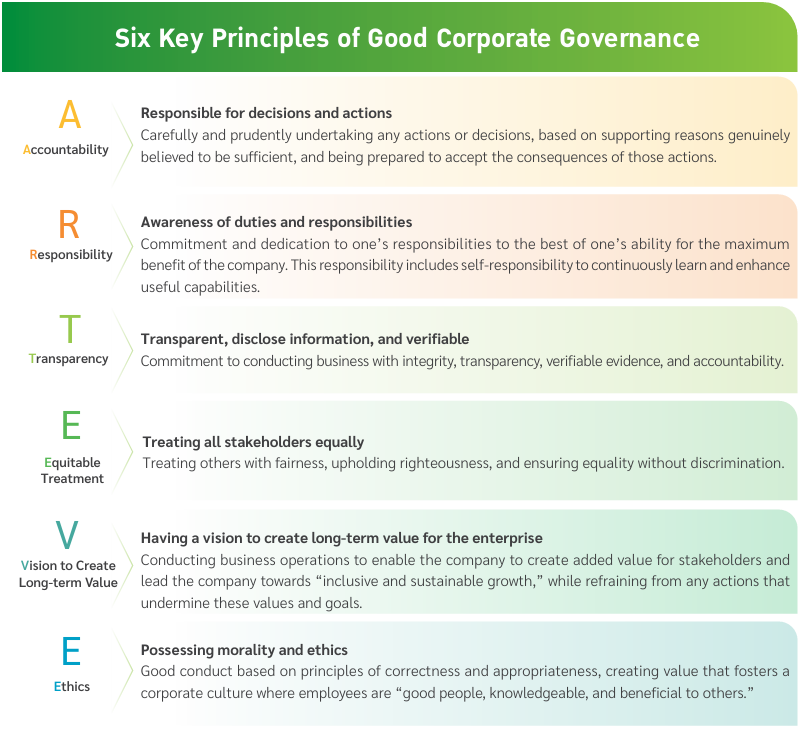
The Board of Directors is committed to promoting the Company as an organization that conducts business under the principles of good corporate governance and possesses a standardized management system. The aim is to maximize benefits for shareholders and consider all stakeholders, operating with integrity, transparency, and verifiability. Therefore, a written Good Corporate Governance Policy has been established since 2003, partly as a result of workshops where all employees participated in conceptualizing and defining guidelines for operations. In the past, the Company has focused on building knowledge and understanding of good corporate governance principles and fostering awareness to apply these principles in daily work, thereby creating an organizational culture. Furthermore, the good corporate governance system has been developed by continuously monitoring and studying good corporate governance practices both domestically and internationally. The Board of Directors deems it appropriate to review and revise the policy annually to serve as a guideline for the Board of Directors, executives, and employees in their operations.
Policy Document Link
https://www.bangchak.co.th/storage/document/cg-policies/cg-policy-2023-en.pdf
Policy & Practices — Board of Directors
Introduction
The Board of Directors, as the leader and ultimate responsible body of the organization, plays a crucial role in overseeing the Company to ensure long-term good performance, credibility for shareholders and stakeholders for the Company's utmost benefit, and sustainable value creation for the business. The Board of Directors is independent of management, performs its duties with responsibility, prudence, honesty, and in accordance with laws, objectives, regulations, and resolutions of the Board of Directors, as well as resolutions of the shareholders' meeting. The Company has established policies and guidelines regarding the Board of Directors as follows:
Composition of the Board of Directors
• The Board of Directors shall consist of no less than 5 and no more than 15 directors, and at least half of the total number of directors must reside in the Kingdom and possess qualifications as prescribed by law and the Company's Articles of Association, without discrimination based on gender or any other differences.
• The Board of Directors comprises at least one-third independent directors of the total number of directors.
• The Board of Directors consists of individuals with extensive knowledge, expertise, and experience in oil business, retail business, energy business, international business, or other related businesses such as petroleum exploration and production, power plants, renewable energy, etc., as well as in accounting and finance, management, legal affairs, organizational development and innovation, information technology and digital, social, environmental and safety, and risk management and crisis situations. At least one director must possess knowledge and expertise in accounting and finance, and at least one non-executive director must have experience in the core business or industry in which the Company operates.
• The Chairman of the Board should be an independent director and must not be the same person as the Chief Executive Officer and President, nor hold positions in any sub-committees established to ensure clear segregation of duties and operations. In cases where the Chairman is not an independent director, independent directors must constitute more than half of the total directors, or one independent director must be appointed to co-consider the agenda for Board meetings.
• New directors must undergo an orientation to understand the objectives, key goals, vision, mission, organizational values, nature and approach of business operations, relevant regulations, good corporate governance policy, and other necessary and beneficial information for effective performance of duties.
• Directors must possess knowledge and understanding of their roles and responsibilities and must complete at least one director-related course from the Thai Institute of Directors (IOD), such as the Director Accreditation Program (DAP) or the Director Certification Program (DCP), or an equivalent program, to continuously enhance their performance skills.
Independent Directors
To ensure that independent directors serve as a crucial mechanism for good corporate governance, safeguarding the interests of the Company and its shareholders, by balancing the decision-making power of the entire Board, and by performing their duties with integrity, upholding correctness, and expressing independent opinions without being influenced by any individual or group, the Board of Directors has defined the definition and qualifications of independent directors in its Good Corporate Governance Policy, which are stricter than the requirements of the Securities and Exchange Commission (SEC) and the Stock Exchange of Thailand (SET) regarding shareholding not exceeding 0.5% (whereas the law stipulates 1%) of the total voting shares of the Company, its parent company, subsidiaries, associated companies, major shareholders, or controlling persons and related persons of the independent director.
The Board of Directors comprises at least one-third independent directors of the total number of directors. The Company has stipulated that independent directors must possess the following qualifications:
1. Not hold more than 0.5% of the total voting shares of the Company, its parent company, subsidiaries, associated companies, major shareholders, or controlling persons of the Company. This includes the shareholding of related persons of that independent director.
2. Not be or have been an executive director, employee, staff, salaried advisor, or controlling person of the Company, its parent company, subsidiaries, associated companies, same-tier subsidiaries, major shareholders, or controlling persons of the Company, unless such characteristics have ceased for at least 2 years. However, this prohibition does not include cases where an independent director was previously a government official or an advisor to a government agency that is a major shareholder or controlling person of the Company.
3. Not be a person who has a blood relationship or a legal registration relationship as a father, mother, spouse, sibling, or child, including the spouse of a child, of other directors, executives, major shareholders, controlling persons, or individuals proposed to be directors, executives, or controlling persons of the Company or its subsidiaries.
4. Not have or have had a business relationship with the Company, its parent company, subsidiaries, associated companies, major shareholders, or controlling persons of the Company in a manner that may impede their independent judgment, and not be or have been a significant shareholder or controlling person of those who have a business relationship with the Company, its parent company, subsidiaries, associated companies, major shareholders, or controlling persons of the Company, unless such characteristics have ceased for at least 2 years.
5. Not be or have been an auditor of the Company, its parent company, subsidiaries, associated companies, major shareholders, or controlling persons of the Company, and not be a significant shareholder, controlling person, or partner of an audit firm where an auditor of the Company, its parent company, subsidiaries, associated companies, major shareholders, or controlling persons of the Company is affiliated, unless such characteristics have ceased for at least 2 years.
6. Not be or have been any professional service provider, including legal or financial advisors, who received service fees exceeding Baht 2 million per year from the Company, its subsidiaries, associated companies, major shareholders, or controlling persons of the Company, and not be a significant shareholder, controlling person, or partner of such professional service provider, unless such characteristics have ceased for at least 2 years.
7. Not be a director appointed as a representative of directors of the Company, major shareholders, or shareholders related to major shareholders of the Company.
8. Not engage in any business that is of the same nature and significantly competes with the business of the Company or its subsidiaries, or not be a significant partner in a partnership, or be an executive director, employee, staff, salaried advisor, or hold more than one percent of the total voting shares of another company that engages in a business of the same nature and significantly competes with the business of the Company or its subsidiaries.
9. Possess no other characteristics that would prevent them from providing independent opinions on the Company's operations. After being appointed as an independent director with characteristics conforming to items 1 to 9, independent directors may be assigned by the Board of Directors to make decisions regarding the operations of the Company, its parent company, subsidiaries, associated companies, same-tier subsidiaries, major shareholders, or controlling persons of the Company, with decisions made in a collective manner (Collective Decision). The definition of an independent director shall be in accordance with the announcement of the Capital Market Supervisory Board.
Sub-committees
The Board of Directors appoints sub-committees for good corporate governance, which are responsible for studying and screening the work of the Board of Directors. These include the Audit Committee, the Nomination and Remuneration Committee, Strategy Transformation and Risk Management Committee, and the Sustainability and Corporate Governance Committee.
Has Policy & Guidelines for the Board
Yes
Board Guidelines
| Guideline | Other — Please Specify | Detail | Document Link |
|---|---|---|---|
| Nomination of Directors | Director Nomination In nominating directors, the Company prioritizes individuals with knowledge, capabilities, experience, a strong work history, leadership qualities, broad vision, as well as integrity, ethics, and a positive attitude towards the organization, who can dedicate sufficient time, which is beneficial to the Company's operations. Furthermore, the Company considers Board Diversity in the structure of the Board of Directors and prepares a Board Skills Matrix to define the qualifications of desired directors, taking into account essential missing skills, as well as suitable qualifications that align with the composition and structure of the Board according to the Company's business strategy. The Company will also utilize the Director Pool database of the Thai Institute of Directors (IOD) as a component in the nomination of new directors, ensuring a transparent process that builds confidence among shareholders.
Diversity of Directors The nomination of directors will consider the benefits of Board diversity in various aspects, including educational background, professional experience, skills, and knowledge, without limitation to gender, age, race, nationality, religion, or any other differences. | https://www.bangchak.co.th/storage/document/cg-policies/cg-policy-2023-en.pdf | |
| Determination of Director Remuneration | The determination of director remuneration (monthly remuneration, meeting allowance per attendance, and bonuses) aligns with the Company's long-term strategies and goals, and is comparable to industry practices, considering experience, duties, roles, and responsibilities (Accountability and Responsibility), as well as the expected benefits from each director and increased assignment of duties and responsibilities. The director remuneration is sufficient to attract qualified directors and enable them to perform their duties to achieve the Company's defined goals and business direction, through a transparent process that builds confidence among shareholders. | https://www.bangchak.co.th/storage/document/cg-policies/cg-policy-2023-en.pdf | |
| Independence of the Board of Directors from the Management | The Company recognizes the importance of having a Board of Directors that can operate independently from management to ensure effective, transparent corporate governance in accordance with good corporate governance principles, particularly in terms of checks and balances, strategic policy formulation, and monitoring the performance of the executive management to align with the company's long-term objectives. The Company's governance structure mandates a clear separation of roles and responsibilities between the Board of Directors and management. The Chairman of the Board is not the same person as the Chief Executive Officer and President of the Company. This is to avoid centralizing policy-making and management authority in a single individual, which could affect the impartiality of the Board's deliberations and decisions. Furthermore, the Chairman of the Board does not hold any position in the company's sub-committees, enabling them to independently and comprehensively oversee, supervise, and advise the Board and various sub-committees. This structural arrangement allows the Chairman to focus on defining the operational direction of the Board, promoting the participation of all directors, and fostering a balanced exchange of opinions between directors and management. The clear separation of roles and responsibilities among the Chairman of the Board, management, and sub-committees helps strengthen an appropriate system of checks and balances, reduces the risk of conflicts of interest, and enhances transparency in the company's decision-making processes. This enables the Board to effectively perform its duties in overseeing, monitoring, and evaluating management's performance, truly considering the best interests of the company, shareholders, and all stakeholders. The Board of Directors operates in conjunction with management. In the following matters:
The Board of Directors Should not be undertaken. In the following matters:
In this regard, the Chief Executive Officer and President has primary authority and duties regarding the Company's operations and daily management as assigned by the Board of Directors, and must manage the Company strictly in accordance with the policies, plans, and budgets approved by the Board, with integrity, honesty, and diligence in safeguarding the interests of the Company and its shareholders. | https://www.bangchak.co.th/storage/document/cg-policies/cg-policy-2023-en.pdf | |
| Director Development | Director Development The Company encourages the Board of Directors to undertake further study and training to enhance their knowledge and understanding of the roles and responsibilities of company directors in efficient management and in accordance with good corporate governance principles. This is achieved by subscribing all directors to the Thai Institute of Directors Association (IOD) for the benefit of receiving news and acquiring additional knowledge. New Director Orientation The Company arranges an orientation for new directors, which includes a visit to the business operations and lectures on various topics to ensure new directors are informed about the nature and business approach of the Company. This encompasses the organizational management structure, business strategies and policies, business performance and operating results, relevant regulations, good corporate governance policy, duties of the Board of Directors, and other necessary and beneficial information for directors to perform their duties effectively. Additionally, a director's handbook and relevant guidelines are provided. | https://www.bangchak.co.th/storage/document/cg-policies/cg-policy-2023-en.pdf | |
| Board Performance Evaluation | 1. The Board of Directors mandates performance evaluations at least once a year, both in the form of individual self-evaluation and cross-evaluation, as well as self-evaluation by the Board as a whole, to enable the Board of Directors to review performance and identify issues for further development of its duties. 2. The Board of Directors has established systematic criteria for comparing performance, with continuous review and improvement, and discloses these criteria, procedures, and evaluation results in the Company's annual report. The Board may consider engaging external consultants to assist in establishing guidelines and evaluating the Board's performance at least every three years and disclose such actions in the annual report. | https://www.bangchak.co.th/storage/document/cg-policies/cg-policy-2023-en.pdf | |
| Corporate Governance of Subsidiaries and Associated Companies | The Company conducts its business through subsidiaries, associates, and joint ventures. Details are presented under the heading 'Shareholding Structure'. The Board of Directors has oversight mechanisms in place to control and supervise the management and operational responsibilities of these subsidiaries, associates, and joint ventures, thereby safeguarding the Company's investment interests. | https://www.bangchak.co.th/storage/document/cg-policies/cg-policy-2023-en.pdf | |
| Other guidelines regarding the board of directors | Term of Office | At every Annual General Meeting, one-third of the directors shall retire from office. If the number of directors cannot be divided exactly into three parts, the number closest to one-third shall retire. Directors retiring by rotation may be re-elected. However, the appropriate term of office for a director should not exceed 3 consecutive terms, unless a director is deemed suitable to serve for a longer period. In such cases, the Board of Directors shall consider the independence and performance efficiency of that director, and provide reasons along with their performance results to the shareholders. Independent directors should not serve for more than 9 consecutive years, starting from the date of their initial appointment as an independent director. Should any independent director be re-appointed to continue serving as an independent director, the Board of Directors shall reasonably consider the necessity of such re-appointment. | https://www.bangchak.co.th/storage/document/cg-policies/cg-policy-2023-en.pdf |
| Other guidelines regarding the board of directors | Board of Directors Meeting |
| https://www.bangchak.co.th/storage/document/cg-policies/cg-policy-2023-en.pdf |
| Other guidelines regarding the board of directors | Board of Directors' Requirements on Succession Plan and Senior Executive Development | The Board of Directors ensures the existence of a Succession Plan to prepare for the succession of the Group Chief Executive Officer and President/Managing Director, and senior executives. It also requires the Group Chief Executive Officer and President/Managing Director to report on the plan's implementation at least once a year. Furthermore, a policy has been established for the recruitment of the Group Chief Executive Officer and President/Managing Director, stating that if suitably qualified, external individuals or employees at the Senior Director level or higher may be considered for selection for the position of Group Chief Executive Officer and President/Managing Director, to ensure maximum benefit. Additionally, the Nomination Committee is assigned to consider the criteria and methods for the recruitment, development, and evaluation of the Group Chief Executive Officer and President/Managing Director, as well as the criteria and compensation structure for the Group Chief Executive Officer and President/Managing Director. The Nomination and Remuneration Committee has completed its consideration and nomination of qualified external candidates and/or employees at the level of Deputy Managing Director who meet the prescribed criteria under the succession plan for the positions of the Group Chief Executive Officer and President. The Company is currently in the process of preparing for the succession of the Group Chief Executive Officer and President. The Board of Directors ensures that the Group Chief Executive Officer and President/Managing Director, and senior executives possess the necessary skills and attributes to drive the organization towards its goals. This is achieved by assigning the management to appoint a "Human Resources and Management Development Committee" responsible for overseeing the training and development of senior executives' knowledge and capabilities. The Group Chief Executive Officer and President/Managing Director are required to report annually on the activities undertaken during the year, which should be considered in conjunction with the succession plan. Furthermore, the Board of Directors has established additional development guidelines, including the rotation of responsibilities among senior executives to foster understanding, experience, and readiness for overall organizational management. | https://www.bangchak.co.th/storage/document/cg-policies/cg-policy-2023-en.pdf |
Code of Conduct
Has a Business Code of Conduct
Yes
Code of Conduct Description
The Company commands written code of conduct as part of the Corporate Governance Policy, regarded as its definition of business standard and personnel behavior, together with the governance of its key corporate culture. The code of conduct states guidelines for good practices reflecting awareness of responsibility and work ethics, which are linked to and support The Company vision, objectives, goals, and strategies. As role models and CG leaders, the Board ensures that management commands tools for establishing and driving a corporate culture firmly underlined by ethics and a code of conduct in all work processes.
Code of Conduct Link
https://www.bangchak.co.th/storage/document/cg-policies/cg-policy-2023-en.pdf
Code of Conduct Practices
| Guideline | Detail | Document Link | Page Number in Report |
|---|---|---|---|
| Prevention of Misuse of Inside Information | The corporate governance policy, the guidelines for directors, management and employees stipulated that they must refrain from any act posing potential conflicts of interest with the Company, i.e. any act potentially depriving the Company of its interests or its fair share of interests, including competing with the Company, incurring personal gains from private business dealing with the Company, abuse of Company information for personal gain and holding shares in the Company’s business competitors. The Company, in order to prevent potential conflicts of interest, has set the following forms: 1. Form for Reporting Compliance with Good Corporate Governance Policies: To comply with the policy on corporate governance, which forbids directors, management and employees to commit any act which might deprive the Company of its interests, the Company has prepared the aforementioned form to ensure that all employee acknowledge the CG policy and fill any acts or activities that might be in conflict with the Company’s business interests and deliver it to their supervisors through online method. In 2025, all requirement was completed, and no significant conflict of interest was identified. 2. Report of Directors and Management’s Interest Form: The Securities and Exchange Act stipulates that directors and the management are to report to the Company his/ her or connected persons’ interest connected with the business operations of the Company or its subsidiaries. The Company has therefore prepared the aforementioned form for its directors and management to fill out and report any change to the Company. The Corporate Secretary will forward a copy of the form to the Chairman of the Board and the Chairman of the Audit Committee to ensure that the directors and management perform their duties with integrity. By the year 2025, this was completed. 3. Report on connected transactions: To ensure that transactions between the Company and any related parties or businesses are transparent and comply with SET’s rules and regulations, the Company has defined a policy and guidelines on connected transactions and prepared the aforementioned form for responsible employees to fill out and forward it to the Secretary to the Board of Directors Division with a copy to Internal Audit for acknowledgment. 4. Intention to trade Bangchak Corporation’s securities form: To enable directors and the management to inform the Company of the intention to trade the securities of the Company to Secretary to the Board of Directors Division at least one day in advance. Written notices can be sent through bcpsecretary@bangchak.co.th or other electronic channels, including the LINE application. The Company also has penalties against employees who use the Company’s any action which is contrary to the business interests of the Company, ranging from a warning to termination of employment. | https://www.bangchak.co.th/storage/document/cg-policies/cg-policy-2023-en.pdf | |
| Anti-corruption | Anti-Corruption The Company incorporated business ethics for anti-corruption in all forms into its corporate governance policy and campaigned for ongoing anti-corruption in the organization through various channels. The Company has integrated the anti-corruption policy into its corporate governance policy under Section 4 to reiterate its intention to operate business by abiding by the law and regulations relevant to corporate governance, refusing all forms of fraud and covering all businesses in all applicable countries and agencies. It has defined anti-corruption measures to implement the policy and has regularly reviewed them to comply with changes in laws and business circumstances and uphold the Company’s reputation. • The Company is committed to complying in full of all applicable anti-money laundering laws. Bangchak will only get involved in legitimate business activities with funds derived from legitimate sources. Bangchak is determined to prevent the Company from falling into any cycle of money laundering and will not tolerate or support any acts of money laundering, including concealing, conversion, transfer, or the handling of illegitimate assets. Also, accurate accounts and records of all transactions, financial facts, and assets must be professionally and properly maintained as stipulated by applicable laws. • It is forbidden to hire government employees or officers (Revolving Door), leading to conflicts of interest. The Company recruits personnel that used to serve as government employees under its own criteria to prevent interpretation as a return of favor for benefits; for transparency and auditability, it also discloses such information. At present, the Company does not employ government employees or officers to do work that causes conflicts of interest. • The Company has established disbursement regulations by defining financial limits, approval authorities, objectives, and recipients, all of which require clear supporting documents to prevent unlawful political help and ensure that charitable donations do not go to corrupt purposes, business support funds are not excuses for corrupt practices, and receptions, gifts, and other expenses conform to the policy. Also in place is an audit process issued by Internal Audit. • The Company has regularly established processes for auditing sales and marketing, purchasing, and contract administration concerning risk to corrupt practices in conformance to disbursement regulations and purchasing regulations. To this end, Internal Audit provides its comments and explores for suitable corrective actions. • The Company has put in place a personnel administration process that underscores its commitment to anti-corruption measures, ranging from selection, training, performance assessment, compensation, to promotion. • The Company has established internal control for finance, accounting, data recording, and other company processes related to anti-corruption measures, together with control self-assessment for consultation about the findings of internal control. • The Company has established risk management to ward off and suppress frauds and malfeasance, by analyzing business risks, defining the importance of risks and proper measures for assessed risks, and regularly tracking the progress of risk management plans. • The Company has put in place internal audit to ensure that the defined internal control system and risk management can help it achieve goals, and to audit all units’ work against requirements and regulations. Internal audit also helps detect weaknesses and provides advice on the development of business processes for greater efficiency and effectiveness under the approach of corporate governance. The Anti-Corruption policy applies to all Bangchak directors, executives, and employees and its subsidiaries. The relevant implementing measures apply to all affiliates and other companies that the Company has control over, as well as its business agents. The Company commands a process for appropriate and fair punishment of employees who violate its anti-corruption measures. Direct and indirect violation of the policy call for disciplinary action under the Company’s explicit procedures. In 2025, it detected such an offense as shown in the whistleblowing report. The Company also joined the UN Global Compact and in 2013 was one of the first 22 companies to achieve CAC (Thai Private Sector Collective Action Against Corruption: CAC) membership certification. Achieving the first CAC membership in 2013 thanks to ongoing transparent business conduct, in 2025, the Company received its fourth consecutive renewal of the CAC certification, following the first renewal in 2016. Bangchak continued to encourage its business partners to join the CAC project. The Company assisted with the public relations and invited the business partners who announced their intention with CAC Road to join CAC Road to Certify and SME Clinic seminar to receive information and knowledge about the laws, case studies along with guidance on how to formulate policies and practices in the preparation of risk assessment methods as well as the process of submitting certification with CAC. As a result, in 2025, the Company also joined the CAC Change Agent program to expand a network of transparent, fair, and zero-corruption business network. | https://www.bangchak.co.th/storage/document/cg-policies/cg-policy-2023-en.pdf | |
| Whistleblowing and Protection of Whistleblowers | The Board has established measures for whistleblowing or complaint-making against unlawful or unethical action or behavior that may be regarded as malfeasance or fraud by any person in the organization, whether employees or stakeholders, as well as inaccurate financial reports or a faulty internal control system. Bangchak has also set up a protection mechanism for whistleblowers so that stakeholders may contribute to more efficient stewardship for Bangchak’s benefit. If Internal Audit Division gets a complaint about possible wrongdoing, it will appoint an investigation panel consisting of representatives of disinterested units to launch an investigation and proceed under the following rules: Matters for which whistleblowing or complaint-filing applies: - Unlawful practices, frauds against company regulations, or violation of the code ofconduct by directors, executives, and employees - Irregularities of financial reports or defects in the internal control system - Matters affecting Bangchak’s interests or reputation. Channels to Report or Complain Internal Audit Division Bangchak Corporation Public Company Limited 2098 M Tower, 8th Floor, Sukhumvit Road Phra Khanong Tai Subdistrict, Phra Khanong District, Bangkok 10260 E-mail: ico@bangchak.co.th Telephone: 0 2335 4566 Whistleblower Protection Mechanisms - Set up a database for confidential information of whistleblowers and, if such information is disclosed, set up punitive measures for responsible people. - This database must be made accessible to executives at the level of Senior Executive Vice President only. - It falls under the authority of the superiors or supervisors of all those accused to give proper directives to protect whistleblowers, witnesses, and those who handed evidence to the investigation to keep them out of danger, trouble, or unfairness due to their making complaints, serving as witnesses, or giving information. | https://www.bangchak.co.th/storage/document/cg-policies/cg-policy-2023-en.pdf | |
| Preventing the Misuse of Inside Information | 1. Maintain and ensure that information recipients maintain confidentiality and market-sensitive information through suitable access methods and keep it from other employees or unrelated parties. 2. Employees must not exploit inside or confidential information of the Company or the Bangchak Group, such as plans, revenues, resolutions, business forecasts, experiments, and bidding, in a way that harms the Company or for the benefit of oneself or others through the trading of securities of the Company and/or subsidiaries in the Bangchak Group listed on the Stock Exchange of Thailand and abroad. They are forbidden to engage in any action by themselves or assign other parties to act for the benefit of themselves or others or for any other illicit benefit. Where inside information occurs, the Company must establish an insider list and set out a blackout period prohibiting the trading of securities of the Company and/or subsidiaries in the Bangchak Group listed on the Stock Exchange of Thailand and abroad and/or target companies also listed on the Stock Exchange of Thailand and abroad. Those equipped with inside information must not engage in such securities trading until at least one day after the entire disclosure of the information. | https://www.bangchak.co.th/storage/document/cg-policies/cg-policy-2023-en.pdf | |
| Prevention of money laundering | The Company is committed to complying in full of all applicable anti-money laundering laws. The Company will only get involved in legitimate business activities with funds derived from legitimate sources. The Company is determined to prevent the Company from falling into any cycle of money laundering and will not tolerate or support any acts of money laundering, including concealing, conversion, transfer, or the handling of illegitimate assets. Also, accurate accounts and records of all transactions, financial facts, and assets must be professionally and properly maintained as stipulated by applicable laws. | https://www.bangchak.co.th/storage/document/cg-policies/cg-policy-2023-en.pdf | |
| Giving or receiving gifts, entertainment, or business entertainment | Directors and employees must refrain from accepting gifts or things regardless of its value. They shall not accept nor offer an entertainment, facilitating payment and other expenditure in an excessive, improper fashion from/to government officials or persons in business dealing with Bangchak. If given gifts of excessive value during traditional occasions of gift exchange, they must refuse such gifts and report to their respective superiors. | https://www.bangchak.co.th/storage/document/cg-policies/cg-policy-2023-en.pdf | |
| Compliance with laws, rules and regulations | Business Code of ConductRespect for Laws and Human Rights The Company places great importance on and is committed to complying with all laws applicable to its business operations in every country in which it operates. Employees are required to strictly respect and adhere to relevant laws, as well as local customs, traditions, and cultural norms. In addition, the Company upholds human rights principles in accordance with legal requirements and international standards. Employee Code of Conduct Employees must perform their duties with responsibility and integrity, while safeguarding the Company’s interests for the benefit of efficiency and pursuit of excellence under good corporate governance. Conduct and Behavior Among Employees 1. Carry out all duties with integrity, attentiveness, and seriousness to foster quality, efficiency, and development of the Company toward excellence 2. Strictly comply with relevant laws, rules, regulations, goals, and plans under the approved budget. 3. Refrain from engaging in any business or investment that could potentially compete so with the Company, whether for personal or for others’ gains. An exception applies if superiors and IA have been notified, and if such engagement is approved, beforehand. Treatment of Colleagues 1. Respect others’ rights and refrain from slandering others. 2. Refrain from giving gifts to superiors or accepting gifts from subordinates 3. Superiors should be respectable to employees while employees should refrain from showing disrespect to superiors 4. Jointly forge and maintain unity among the workforces. Acceptance or Giving of Gifts Refrain from requesting, accepting or agreeing to accept, including give or offer to give any improper things for example money, things or any other benefits to customers, business partners, contractors, agents, and sellers of products and services to the Company, or from any parties engaging in businesses with it. | https://www.bangchak.co.th/storage/document/cg-policies/cg-policy-2023-en.pdf | |
| Use and maintenance of data and assets | The Company places importance on safeguarding the confidential and Market Sensitive Information and requires person who have access to such information to maintain it confidentiality. The Company strictly prohibits the misuse of inside information or confidential information of the Company, or Bangchak Group of Companies for own or other’s benefit, and refrain from using them for other businesses and respect of other person's assets. “Assets” means tangible/intangible assets such as movable/immovable properties, technology, academic knowledge, document of right, intellectual property, including confidential information such as business plan, financial forecast, and human resource data. Respect for Intellectual Properties 1. Employees must maintain and safeguard Bangchak’s intellectual property rights, while respecting and maintaining others’ intellectual property rights. 2. Employees must not replicate, modify, or exploit intellectual properties and confidential information of Bangchak, its business partners, and stakeholders by any means for personal or others’ gains without prior permission. 3. Employees must report to superiors whenever they encounter violations of intellectual property rights, actions potentially leading to such violations, or actions potentially leading to disputes about Bangchak’s or others’ intellectual property rights. | https://www.bangchak.co.th/storage/document/cg-policies/cg-policy-2023-en.pdf | 16 |
| Anti-competitive | The Company conducts its business ethically and transparently without taking unfair advantage of its competitors or seeking confidential information through illicit means. It does not defame competitors through slander. This includes opposing unfair competition, promoting fair competition, and refraining from any actions that distort market prices, which would harm consumers. | https://www.bangchak.co.th/storage/document/cg-policies/cg-policy-2023-en.pdf | 48 |
| Cyber security | Use of Information Technology (IT) 1. Employees must strictly comply with applicable laws governing and guidelines for Bangchak’s IT applications. 2. Employees must include IT as part of the strategies and operation to improve their businesses and enhance business opportunities with prudence and care. The Company has adopted a system for documents and evidence of delegating responsibility should errors arise. Custody of company assets prevents losses or abuses, as does monitoring transactions with long-term corporate commitment by complying with agreed terms. Measures are in place to prevent the exploitation of opportunities or benefits for personal gain. The Company reiterated procedures on corporate data management and control to employees so that all units may effectively treat company information to avoid any harm to the business. The Company incorporated procedures to ensure compliance with laws, applicable regulations, and key operating procedures. Technology systems have been developed to promote internal control. The Company rolled out its “Work process management policy,” which seriously takes proper work practices by designated work processes. Work processes are constantly improved for effectiveness with due regard for points of control and control measures to minimize risks; these efficient processes are modern and align with Bangchak’s directions and goals. The e-Work Manual system tracks the preparation and update of work manuals to be up to date while instilling knowledge about the law in various departments to ensure legal compliance. The Company adopted stringent measures for its transactions with major shareholders and directors, among others, to avert the siphoning of benefits. For instance, such transactions must be approved by those without vested interests, and the data of such transactions must be disclosed under SEC’s rules, including data on parties or related undertakings under accounting standards. The Company established an ISMS Management Team responsible for overseeing and managing information security. The team reviews and improves policies and procedures for safeguarding information technology systems and measuring effectiveness. Advanced technology systems such as email filters, malware protection, and firewalls are implemented to monitor and prevent new and complex threats. There are regular updates to information technology security measures, personal data protection law compliance, abnormal event monitoring, threat preparedness and protection plans, and regular cybersecurity exercises. Employees are informed of information technology security requirements and regularly educated about new risks and prevention methods. Additionally, measures are in place to raise awareness of threats that could potentially harm the business. The company has thus been certified with the ISO/IEC 27001:2022 standard for Information Security Management System (ISMS), which is the latest version and has also obtained certification for ISO/IEC 27018:2019, which relates to personal data protection on public cloud systems. Furthermore, the company has received a Letter of Compliance with the Guidelines for Cybersecurity (ISO/ IEC 27032:2012), being the first to receive such certification in Thailand. This certification has been continuously maintained to date. The Company has guidelines for supervision and a process to monitor the operations of associated companies and subsidiaries in accordance with the company’s business strategies, policy framework, and guidelines. The monitoring was conducted through sub-committee and working group, namely Strategy Transformation and Risk Management Committee (STAR), Audit Committee (AC), Strategic Investment Management Committee (SIMC), and Subsidiary Synergy & Strategic Alignment Steering Committee (SSS). | https://www.bangchak.co.th/storage/document/cg-policies/cg-policy-2023-en.pdf | |
| Environmental management | The Company prioritizes resource conservation, encompassing all activities, products, and services that are integral to its core business. This includes minimizing waste and adhering to mandatory state laws and regulations. The company views these regulations as opportunities to enhance operational practices beyond mere compliance. Consequently, the company has established a comprehensive Safety, Security, Occupational Health, Environment, and Energy policy. Adhering to this policy is the direct responsibility of the management, all employees, and contractors working on behalf of the Company. | https://www.bangchak.co.th/storage/document/cg-policies/cg-policy-2023-en.pdf | |
| Human rights | The Company recognizes the importance of managing human rights and environmental issues systematically in business operations that are based on respect for the rights of stakeholders, including people with gender diversity and embracing the diversity of thought and societal equality concerning religion, skin color, ethnicity, including vulnerable groups of society such as women, children, indigenous people, ethnic groups, employees, migrant workers, contractors, partners, customers, local communities, and also the respect for the environment. This approach has been integrated into business operations. This demonstrates the commitment to preventing risks and potential impacts arising from human rights and environmental violations of stakeholders. To assure confidence in conducting business operations that respect human rights, the Company has a corporate responsibility policy towards respecting human rights, adhering strictly to international organizations in human rights such as the UN Global Compact, international guidelines on social responsibility (ISO 26000), the Universal Declaration of Human Rights (UDHR), United Nations Guiding Principles on Business and Human Rights (UNGP), and Women’s Empowerment Principles (WEPs). These frameworks for action are implemented and adhered to by the Company’s Board of Directors, executives, and employees at all levels. Key Activities Human rights and environmental risk assessments are conducted annually. The Company performs comprehensive reviews of human rights issues in accordance with the guidelines of the Human Rights Committee, covering eight dimensions of risk. These include risks related to the construction and expansion of facilities, employees, contractors, communities, and societies, as well as environmental risks within operational areas, customers and consumers, other business-related organizations, cross-border labor utilization, and hiring practices for diverse gender individuals and temporary employees. This encompasses vulnerable groups such as children, women, indigenous peoples, and persons with disabilities within the organization. It also covers the Refinery and Oil Trading Business Group, Marketing Business, and partners throughout the supply chain. Information on human rights activities is disseminated through the Sustainability Report. Supplier assessments are conducted in accordance with the Supplier Code of Conduct framework, which covers business ethics, labor practices and human rights, safety, health, environment, and contributions to community development. The Supplier Code of Conduct was developed to ensure adherence to ethical standards and support employees in addressing issues arising from human rights violations by the partner organization. The Company fosters responsibility and understanding of human rights by organizing training sessions within the operations, prevention, and mitigation of impacts to avoid violating human rights, including the environment and the community, caused by the Company’s activities and supply chain through guidelines with responsible agencies. Establish a mechanism for redress according to the Company’s policy to allocate appropriate budgets and measures to compensate when human rights violations occur. Carry out the guidelines according to the National Action Plan on Business and Human Rights (NAP Implementation), such as - Improving the quality of life of people with disabilities, creating job security, and reducing social inequality, ready to support the under privileged in society to show their potential and abilities in their duties effectively. By providing work opportunities for people with disabilities to become full-time employees. - Creating a labor project under the name “Breastfeeding Promotion Project” by providing a separate breast pump room to continuously offer quality places and facilities for employees to pump breast milk. - Review processes and measures to mitigate impacts and ensure complaints and whistleblowing. In terms of responsibility towards employees, the company respects human rights and fair labor practices, without discrimination based on gender. We provide fair and appropriate compensation, benefits, and other welfare not less than what is stipulated by law. Furthermore, compensation is based on performance evaluation levels and aligned with the company's performance in both the short and long term, comparable to the market and the same industry. We also provide a provident fund, take care of health, hygiene, and a safe working environment, provide training, develop potential and promote advancement, as well as open up opportunities for skills development in other areas. | https://www.bangchak.co.th/storage/document/cg-policies/cg-policy-2023-en.pdf | |
| Occupational health and safety | The Company values the stewardship of safety, occupational health, the environment, and energy to ensure that all activities fall under an international-standard management system that does not harm the environment, society, and communities. The Company is committed to raising its management excellence through approach of the Thailand Quality Awards, which values social responsibility; protection of health, safety, and the environment; and business conduct and employees. In addition, the Company values resource conservation, which encompasses all activities, products, and services all with key business roles; loss prevention; and compliance with the law and public regulations. Viewing these regulations as opportunities for improvement over and beyond what needs to be complied with, the Company devises the SHEE policy, and all executives and rank-and-file employees including all contractors working on behalf of the Company are held directly responsible for SHEE policy. | https://www.bangchak.co.th/storage/document/cg-policies/cg-policy-2023-en.pdf |
Promoting Compliance with the Code of Conduct
Promotes Compliance by Directors, Executives and Employees
Yes
Description
The Sustainability and Corporate Governance Committee has approved the company's good corporate governance plan annually. The company is required to communicate good corporate governance principles and ethics to employees and stakeholders on an ongoing basis through various channels to raise awareness and communicate the company's intentions and operating standards to stakeholders, such as:
Communication on ethical conduct, integrity, and anti-corruption, including good corporate governance practices, is reinforced through a “Tone from the Top” approach. The CEO emphasizes employee culture under the message “To be virtuous, knowledgeable, and contributive to others” during the BCP Townhall. In addition, executives communicate these values to employees at all levels through functional meetings.
Communication on good corporate governance, ethical conduct, integrity, anti-corruption, internal control, human rights in the workplace, and related CG practices is carried out through infographics and internal communications. Employees are required to study this information independently prior to taking the annual assessment.
All employees are informed of and required to comply with the Company’s CG Policy and must annually disclose their personal information and any potential conflicts of interest through the Conflict of Interest Report, or update such information whenever changes arise. Compliance is achieved at 100%.
The Company provides CG e-Learning on good corporate governance to present relevant, practical case studies for employee learning. Employees must study the materials and complete the Good Corporate Governance quiz through the online knowledge management system. In 2025, the Company promoted enhanced understanding of corporate governance, the internal control framework based on the COSO model (The Committee of Sponsoring Organizations of the Treadway Commission), human rights related matters, and key principles of personal data protection under the Personal Data Protection Act B.E. 2562 (2019). The average score of employees completing the training was 96.51%.
The Company places strong emphasis on the No Gift Policy during festive seasons and on all other occasions to enhance corporate governance excellence and foster ethical business practices. This policy is communicated annually to business partners and stakeholders.
Process Document Link
https://www.bangchak.co.th/storage/document/cg-policies/cg-policy-2023-en.pdf
Anti-Corruption Networks & Projects
Introduction
On November 9, 2010, the Company collaborated with the private sector in declaring its intention to join the Thai Private Sector Collective Action Against Corruption (CAC). Subsequently, on 4 October 2013, the Company became one of the first 22 companies to be certified as a CAC member.
Furthermore, recognizing the importance of expanding a transparent business network, the Company actively encourages its business partners to participate in the CAC initiative. The Company has also joined the CAC Change Agent program to continuously expand a zero-corruption business network.
Joined or Declared Intent to Join Anti-Corruption Networks
Yes
Networks & Projects Joined
| Network / Project | CAC Certified |
|---|---|
| Thai Private Sector Collective Action Against Corruption: CAC | Y |
| United Nations Global Compact (UNGC) | |
| Participation of anti-Corruption networks and initiatives |
Material Changes & Developments in CG
Reviewed the CG Policy or Board Charter in the Past Year
Yes
Material Changes or Developments in the Past Year
Yes
Policy Review — Description
The Board recognizes the importance of upgraded corporate governance (CG) practices to become comparable with leading domestic and international companies, which would benefit its pursuit of sustainable growth. It, therefore, annually reviews the suitability and adequacy of the policy and guidelines for its CG and code of conduct to align with its business model and prevailing circumstances, which include laws, rules, guidelines, and stakeholders’ views.
The Board of Directors reviewed and considered the Company’s policies, guidelines, and good corporate governance systems and resolved that the good corporate governance policy of the Company is still appropriate and in line with the requirements of the Corporate Governance Report (CGR) of listed companies, the Thai Private Sector Collective Action against Corruption (CAC), the S&P Global Corporate Sustainability Assessment (S&P Global CSA), and leading companies operating standards on corporate governance, while suiting the current business model.
In 2024, the Company's Corporate Governance Policy was amended as follows:
Appointment of the Company Secretary as the person responsible for receiving notifications of directors’ and executives’ reports on their interests. Directors and executives are required to report their own interests or those of related persons, insofar as such interests are connected to the management of the Company or its subsidiaries. This must be done in accordance with the rules, conditions, and procedures prescribed by the Capital Market Supervisory Board.
Shareholder engagement beyond the Annual General Meeting of Shareholders, through activities aimed at disclosing information on operating results and business outlook to shareholders, banks, credit rating agencies, analysts, and both domestic and international investors. Such activities include Analyst Meetings, Opportunity Day events, Roadshows, and Company Visits, among others.
Implements the CG Code for Listed Companies
No
CG Code — Description
The Sustainability and Corporate Governance Committee and the Board of Directors have reviewed the appropriateness of adopting the Principles of Good Corporate Governance for Listed Companies 2017 (CG Code 2017), taking into consideration the Company’s business context, with the aim of creating sustainable long-term value.
It assessed compliance with each item of the code of Bangchak’s policies, CG practices, and business context, concluding that its overall policies, measures, and business processes aligned with CG Code guidelines and proved appropriate for its business growth directions, except the following matters which are the aspects not yet applied, which will in time be adapted as seen fit.
CG Code Guideline: The appropriate number of directors is between 5 and 12 (Guideline 3.1.2)
Bangchak’s Justification or Alternative Measure: Bangchak’s articles of association requires 5-15 directors. Since 2014, 15 directors have been appointed consistent with the articles of association and business model. As Bangchak has continued its investment in new businesses, it required diversity in directors’ backgrounds, meaning qualifications and competencies fitting business expansion.
Other CG Performance & Outcomes
Thanks to its firm commitment and intention to operate with CG, Bangchak continually ranked high among companies, with CG accolades including.
The Company’s continuous improvement and development of its Good Corporate Governance (GCG) processes, together with its disclosure practices in accordance with the criteria of the Corporate Governance Report of Thai Listed Companies (CGR) conducted by the Thai Institute of Directors (IOD) and The Stock Exchange of Thailand (SET), resulted in the Company achieving a “Very Good” CGR Score in 2025.
In the assessment under the “Annual General Meeting (AGM) Checklist” Project 2025, organized by the Thai Investors Association, the Company received a total score of 96 points, which is considered “Excellent.”